
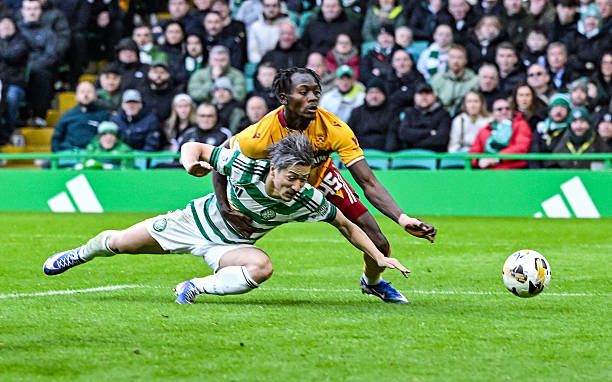
Celtic’s 3-1 victory over Motherwell on the weekend had plenty of talking points, but the game-defining moment came in the second half when Daizen Maeda was bundled over in the box, leading to a penalty and a straight red card for Emmanuel Longelo.
Now, former Premier League referee Dermot Gallagher has explained why the decision was completely correct, even referencing a recent high-profile incident in England involving Liverpool’s Virgil van Dijk.
Speaking on Ref Watch on Sky Sports News, Gallagher highlighted how VAR played a crucial role in ensuring the right call was made.
“I think VAR has done really well for the referee because it’s a foul,” Gallagher stated. “This has to be a red card because the player makes no attempt to play the ball. The ball isn’t anywhere near him, and he just hauls him to the ground.”
The incident occurred after a Celtic corner, with Maeda perfectly positioned at the near post when Longelo grabbed him from behind.
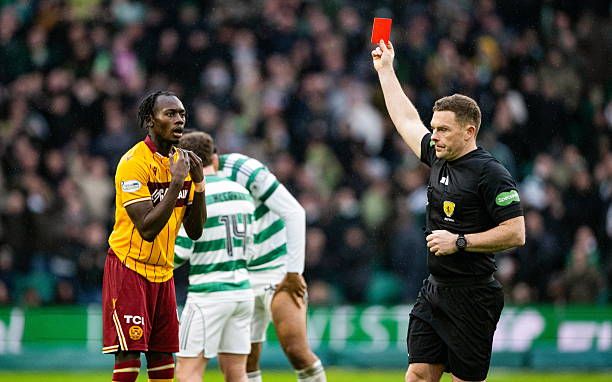
GLASGOW, SCOTLAND – MARCH 14: Motherwell’s Emmanuel Longelo fouls Celtic’s Daizen Maeda (L) which leads to VAR awarding a penalty during a William Hill Premiership match between Celtic and Motherwell at Celtic Park, on March 14, 2026, in Glasgow, Scotland. (Photo by Rob Casey/SNS Group via Getty Images)
In real time, referee John Beaton initially waved play on, but the VAR intervention quickly corrected the oversight, awarding the penalty and issuing the red card. That moment proved pivotal as Celtic went on to secure a crucial three points in the title race.
Gallagher also drew a direct comparison to the recent Premier League clash between Liverpool and Tottenham, when van Dijk pulled back Richarlison during a 1-1 draw.
“In that instance, Richarlison was trying to run through on goal when van Dijk was pulling him by the shoulder and trying to stop his momentum. The Spurs forward still got his shot off, but he felt he was being impeded and should have got a foul, which would have resulted in a straight red card for the Dutchman,” Gallagher explained.
However, Gallagher believes the Celtic incident was far clearer than the van Dijk case. “I think this falls into the van Dijk and Richarlison, where I said to you, if the referee did give a penalty, which I think would have been incorrect there. It’s got to be a red card,” he said.
Adding further context, former Premier League striker Jay Bothroyd highlighted the positioning of the Motherwell goalkeeper as a key factor in the red card decision.
“Just to add to that. The reason why that is a red card is because of where the keeper is. The keeper is out of the goal. It’s an open goal. If the keeper was in the goal, then I would be saying, ‘it’s not an obvious goalscoring opportunity.’ But because he wasn’t there. It is. And it was the right decision.”
Both Gallagher and Bothroyd’s analysis helps explain why Celtic fans were justified in celebrating the decision. The combination of VAR, a clear foul, and the absence of the goalkeeper meant this wasn’t a marginal call—it was a textbook example of a penalty and red card situation.
For Celtic, the moment not only secured the win but also sent a clear message that the Hoops can rely on both their attacking threat and the technology supporting fair officiating in high-pressure matches.
Meanwhile, discussions around refereeing consistency, VAR interventions, and comparing incidents like van Dijk’s in the Premier League continue to dominate conversations among fans and pundits alike, proving that a single decision can have ripple effects far beyond just one game.
As Celtic push on in the Scottish Premiership title race, the Maeda-Longelo incident will be remembered as a turning point—both on the pitch and in wider discussions about the impact of VAR and the standards expected of referees at the highest level.